Proudly serving Tucson, Oro Valley, Marana, Sahuarita, Green Valley, Vail & surrounding areasCall or Text 24/7: 520-699-3263

Stamped Concrete Installation, Overlays & Decorative Pattern Work in Tucson, AZ

Tucson Superior Concrete installs stamped concrete for residential and commercial properties throughout Tucson, Arizona. Our crews build patios, driveways, pool decks, sidewalks, and walkways, along with decorative overlays for structurally sound existing slabs. We also handle slab installation, repair, resurfacing, sealing, maintenance, and demolition when replacement is the better option. Each project is scoped on-site so the design, base preparation, reinforcement, and drainage plan fit the property.

Tucson's dense, calcium-rich caliche layer expands and contracts through summer monsoon downpours and long dry stretches, while concrete surfaces also face 115-degree summers. Pavement temperatures over 150 degrees can stress poorly prepared slabs and joints. We compact sub-base material to specification, follow American Concrete Institute mix-design guidance, and grade surfaces so runoff moves away from foundations. Those details help stamped finishes handle desert heat and seasonal drainage demands while complementing Southwest homes.

Choose from integral color, dry-shake color hardeners, and stone, slate, brick, or wood-plank textures, then protect the surface with a UV-rated solvent- or water-based sealer. Our work is licensed through the Arizona Registrar of Contractors, and we pull permits through Pima County Development Services or the City of Tucson when the scope requires it.

Tucson Superior Concrete provides stamped concrete installation throughout Tucson, Oro Valley, Marana, Sahuarita, Vail, and the greater Pima County area.

★ ★ ★ ★ ★4.9/5 Average Rating · 20+ Years of Experience · Thousands of Customers Helped · Licensed & Insured · Residential & Commercial

Stamped Concrete Options & Benefits

What Is Stamped Concrete?

Stamped concrete is poured and finished as a continuous slab, then textured with rubber mats while the concrete is still plastic enough to accept a pattern. The technique can reproduce the appearance of slate, cobblestone, running-bond brick, or wood planks without installing individual units.

Color can be added throughout the mix with integral pigment or applied as a dry-shake color hardener before stamping. A complementary antiquing release adds depth, and a cure-and-seal coat protects the finished color from Tucson's UV exposure and desert heat.

The result works for patios, driveways, pool decks, entries, and walkways when the slab thickness, reinforcement, drainage, texture, and sealer are selected for the surface. We review physical pattern and color samples at the property because direct Tucson sunlight can make finishes look different from showroom samples.

Benefits of Stamped Concrete

Stamped concrete combines a decorative surface with the structural performance of a properly prepared concrete slab. Design, drainage, reinforcement, and maintenance can all be tailored to the way the area will be used.

  • Creates a continuous surface without individual pavers shifting out of alignment
  • Reproduces slate, stone, brick, cobblestone, and wood-plank textures
  • Costs less than natural stone or clay pavers for a comparable decorative look
  • Uses desert tan, terracotta, and sandstone tones that complement stucco and adobe
  • Coordinates patios, pool decks, and walkways with matching texture and joint layouts
  • Builds drainage slope into the slab instead of relying on surface-level fixes
  • Can last 25 years or more when properly installed and regularly resealed
  • Uses UV-stable sealers to limit chalking, yellowing, fading, and staining
Decorative Concrete Services

Stamped Concrete Services

We tailor stamped concrete to the load, drainage, heat, and slip-resistance demands of each surface. New pours receive purpose-built base preparation and reinforcement, while existing slabs are inspected before an overlay or resurfacing option is recommended.

Stamped Concrete Patios

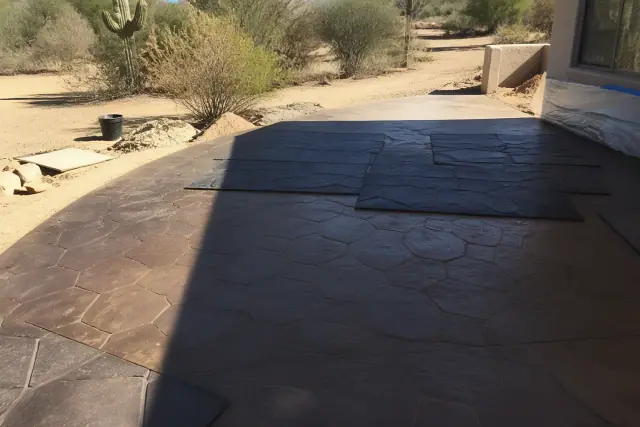
Stamped concrete patio work-in-progress with textured patterns and desert landscaping in Tucson, AZ.

We pour patios for backyard entertaining areas, ramadas, and outdoor kitchens, with a minimum 1/8-inch-per-foot slope away from the house. Most residential patio projects cover 200 to 600 square feet, and patterns and colors can be matched to stucco, block walls, rooflines, adjoining pool decks, and walkways.

Request Estimate

Stamped Concrete Driveways

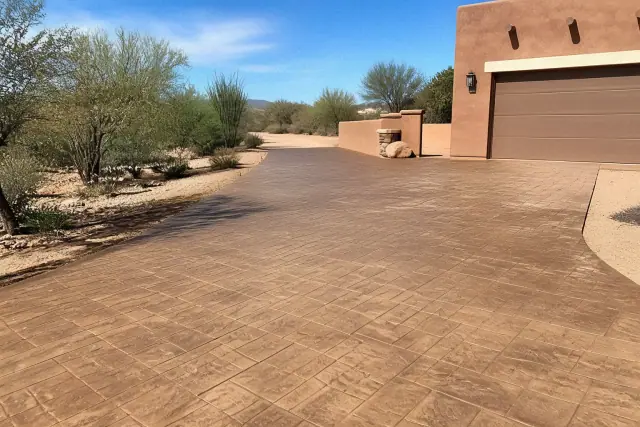
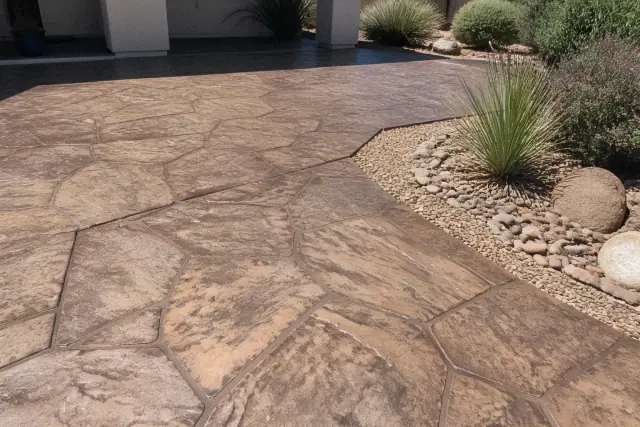
Stamped concrete driveway with stone-like patterns at a residence in Tucson, AZ with desert landscaping.

Driveways receive a minimum 5-inch slab with rebar reinforcement and a sub-base compacted to 95% Proctor density under ACI 330 slab-on-grade guidance. Control-joint spacing and flexible polyurethane joint sealant are planned for daily vehicle loads and Tucson's wide temperature swings.

Request Estimate

Decorative Concrete Pool Decks

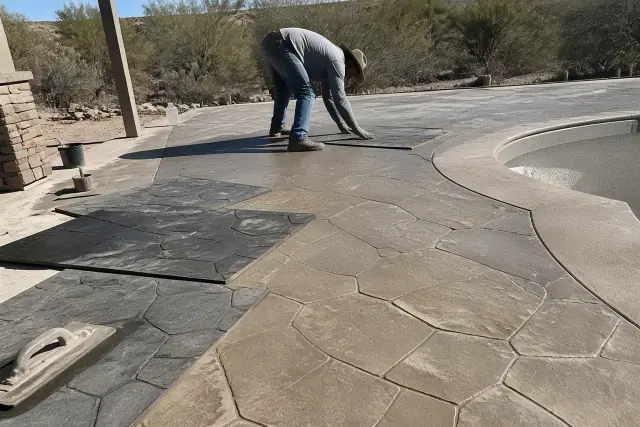
Stamped concrete pool deck with stone-like texture impressions at a jobsite in Tucson, AZ with desert bushes in background.

Pool decks need traction, manageable surface temperature, and reliable drainage. We can combine exposed aggregate or lighter integral color with a knockdown texture, then grade the deck toward drains so splash-out and monsoon rainfall do not collect near coping stones.

Request Estimate

Sidewalks and Entry Walkways

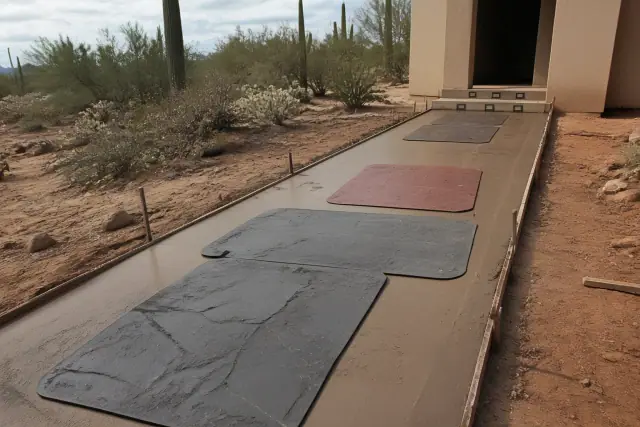
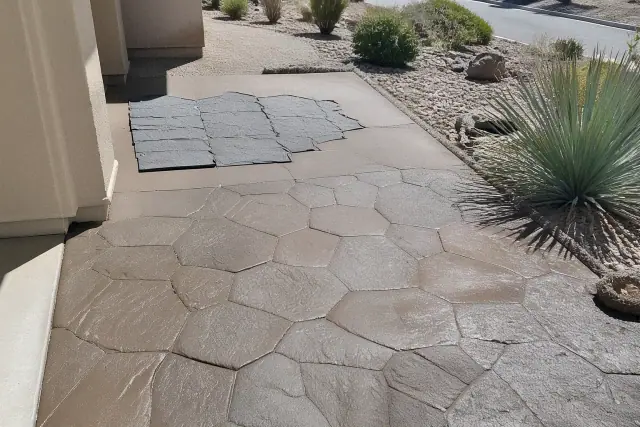
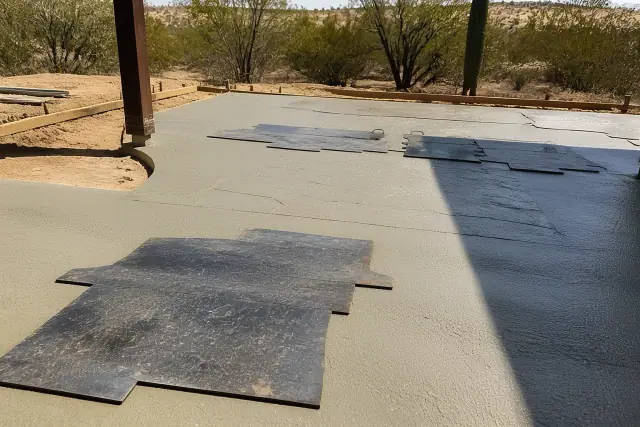
Textured mats pressing a stamped concrete pattern into a walkway at a job site in Tucson, AZ.

Stamped or broom-finished walkways can connect a driveway, garage, and front entry as one cohesive hardscape. Narrow pours receive the same base preparation, reinforcement, finishing, and jointing standards as larger slabs, with ADA slope requirements addressed where public-facing sidewalks fall under Pima County right-of-way standards.

Request Estimate

Stamped Concrete Overlays

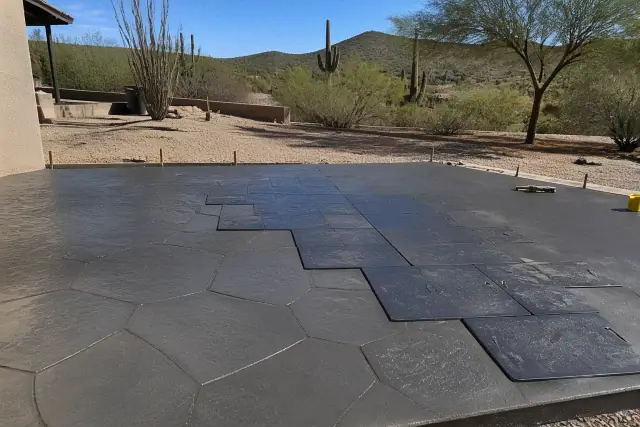
Stamped concrete overlay being imprinted with textured mats in the Tucson, AZ desert with saguaro cacti in the background.

A stampable cement-based overlay can refresh a structurally sound slab at roughly 3/8 to 3/4-inch thickness, giving the material enough body to hold a texture. We do not recommend an overlay when major cracks, heaving, settlement, drainage failure, or a failed sub-base would simply carry the same defects into the new finish.

Request Estimate

Concrete Sealing and Maintenance

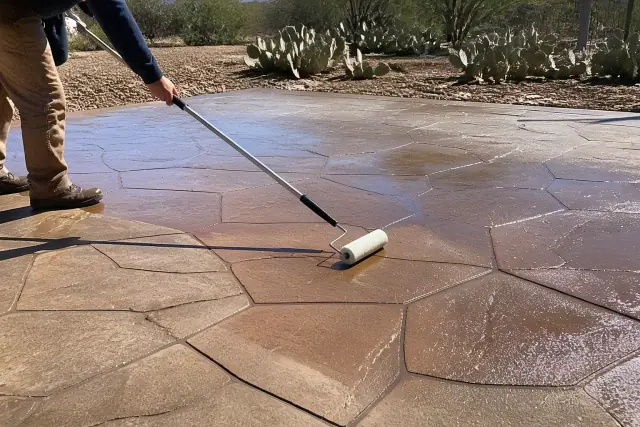
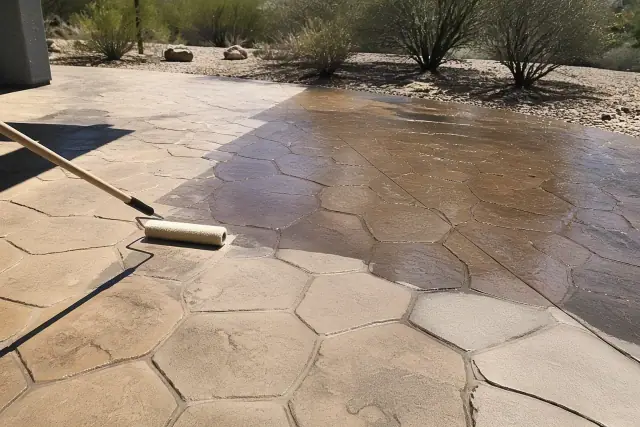
A roller applies a glossy sealer to stamped concrete in Tucson, AZ, with prickly pear cactus in the background.

We apply solvent-based acrylic sealer for richer color and higher gloss or water-based acrylic for a more natural, lower-sheen finish. Most Tucson surfaces need resealing every 2 to 3 years, while high-traffic driveways and pool decks may need attention closer to every 18 months.

Request Estimate
Patterns, Colors & Finishes

Stamped Concrete Design & Finish Options

The right stamped-concrete specification balances appearance with the slab's intended use. Pattern scale, color method, sealer sheen, reinforcement, and the condition of any existing concrete all shape the recommended approach.

Stamped concrete patterns and surface textures being imprinted at a jobsite in Tucson, AZ.

Stamped Patterns and Surface Textures

Pattern choice affects both the architectural character and the feel underfoot. We compare samples at the property so texture scale and shadowing suit the surrounding hardscape.

  • Ashlar slate for broad, irregular stone geometry
  • Cobblestone for a more pronounced traditional texture
  • Running-bond brick for orderly repeating lines
  • Wood-plank stamps for linear grain and board detail
  • Exposed aggregate for a natural, slip-resistant alternative
Request Estimate
Stamped concrete with integral color and antiquing residue on a jobsite in Tucson, AZ.

Integral Color and Antiquing Options

Integral color distributes pigment throughout the mix, while dry-shake hardener and antiquing release can add surface variation and depth. Tucson homes often pair well with lighter earth tones that echo the Sonoran Desert palette.

  • Desert tan for a light, dust-friendly neutral
  • Terracotta for warm adobe and Spanish Colonial exteriors
  • Sandstone for a natural, heat-reflective appearance
  • Two-tone blends with a darker antiquing release
  • Border accents that add contrast without full multi-color layering
Request Estimate
Roller applying clear concrete sealer to a stamped patio in Tucson, AZ, with desert plants and rocky soil in the background.

Concrete Sealer Options

Sealer selection changes the sheen, color depth, and maintenance experience of a stamped surface. Both acrylic options use UV inhibitors intended for extended sun exposure.

  • Solvent-based acrylic for richer color and higher gloss
  • Water-based acrylic for a natural, lower-sheen finish
  • UV inhibitors for prolonged Tucson sun exposure
  • Cure-and-seal protection against fading and monsoon staining
  • Fan-tip washing for gentler routine cleaning
Request Estimate
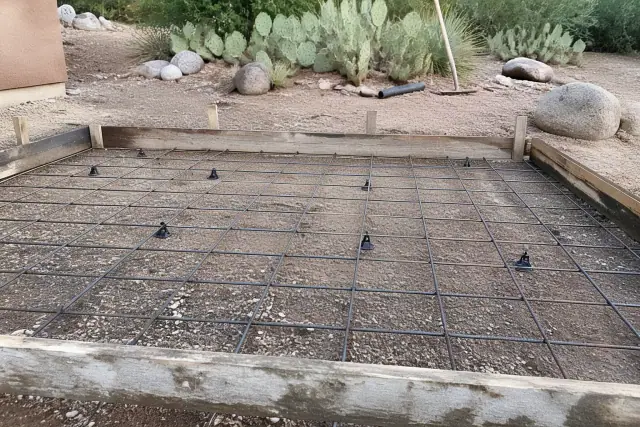
Steel wire grid on plastic spacers for a concrete pour at a worksite with cacti in Tucson, AZ.

Slab and Reinforcement Options

Slab design changes with expected loads, soil conditions, and drainage. Base depth and reinforcement are selected after the site is evaluated rather than applied as a one-size-fits-all detail.

  • Minimum 4-inch patio slabs for typical residential use
  • Minimum 5-inch driveway slabs for regular vehicle loads
  • Compacted aggregate bases excavated to 4 to 6 inches
  • 3/8-inch rebar on 18-inch centers when specified
  • Welded wire mesh where soil conditions and expected loads support it
Request Estimate
Stamped concrete texture being imprinted with polyurethane mats on a jobsite in Tucson, AZ with desert surroundings.

Overlay or Full Replacement

Existing concrete must be structurally sound before it receives a decorative overlay. When movement or base failure is present, demolition and a new pour protect the investment better than covering the symptoms.

  • Use a stampable overlay only on a stable, well-bonded slab
  • Avoid thin microtoppings that cannot hold a stamped pattern
  • Correct drainage failure before installing a new finish
  • Replace panels with major cracking, heaving, or settlement
  • Remove failed sub-base conditions that could telegraph cracks within a year or two
Request Estimate
Finding the Right Fit

Choosing the Right Stamped Concrete Approach

We compare the surface's load, sun exposure, drainage, slip-resistance needs, existing-slab condition, access, and design goals before recommending a specification. An on-site consultation lets you view pattern samples, color boards, and border choices against the home's actual exterior and Tucson lighting.

Caliche-Aware Base Preparation

Dense caliche and expansive soil behavior can undermine a slab when excavation and compaction are rushed. We evaluate the site, compact aggregate to specification, and grade the base and forms around actual drainage conditions before concrete arrives.

Load-Specific Concrete Design

Patios, driveways, walkways, and pool decks do not carry the same loads or face the same surface demands. We follow ACI mix-design guidance and adjust thickness, reinforcement, jointing, texture, and sealer to the intended use.

Licensed Local Project Oversight

Our concrete work is licensed through the Arizona Registrar of Contractors. When a project's scope requires permits, we coordinate them through Pima County Development Services or the City of Tucson and account for the applicable site and right-of-way conditions.

What Sets Us Apart

Why Choose Us for Stamped Concrete Installation?

Tucson Superior Concrete connects decorative decisions to the structural details that determine long-term performance. On-site scoping covers access, base preparation, reinforcement, drainage, patterns, colors, and maintenance before we quote the work, so the proposed surface fits both the property and the way it will be used.

Request On-Site Estimate

Caliche Soil Movement

Tucson's dense, calcium-rich caliche can expand and contract as dry periods give way to monsoon saturation. Inadequate excavation or loosely compacted fill can lead to cracking and settlement even when the surface finish initially looks sound.

Monsoon Runoff and Poor Drainage

At-grade patios and pool decks can direct stormwater toward a foundation or leave standing water near coping when their elevations are wrong. Planned slope, correctly set forms, and connections to existing drainage help move runoff away from vulnerable areas.

Thermal Stress at Control Joints

Tucson conditions range from freezing overnight lows in December to pavement temperatures over 150 degrees in July. We cut control joints at intervals roughly 2 to 3 times the slab thickness in feet and use flexible polyurethane sealant, since rigid caulk may fail within a year or two.

UV Fading and Sealer Wear

Intense sun can fade color, yellow a poor coating, and leave an unprotected surface chalky. UV-stable acrylic sealer and timely reapplication help preserve color depth while limiting dust, mineral, and organic staining.

Cracked or Settled Existing Slabs

An overlay follows the profile and movement of the concrete beneath it. Major cracks across multiple panels, heaving, settlement, or sub-base failure usually call for demolition and replacement instead of a decorative layer that repeats the same damage.

Hot or Slippery Pool Deck Surfaces

Dark colors and heavily raised stamp patterns can become uncomfortable or reduce footing around a pool. Lighter integral colors, exposed aggregate, or knockdown texture can provide a cooler, more slip-conscious surface without ignoring drainage toward deck drains.

How It Works

Our Stamped Concrete Installation Process

A typical project moves through site evaluation, excavation, forming, base compaction, reinforcement, pouring, stamping, and sealing over 3 to 5 days, depending on square footage and weather. Each stage is timed around the slab's structural needs and Tucson's fast surface curing conditions.

01.

On-Site Evaluation and Design

We inspect access, existing concrete, soil conditions, elevations, runoff paths, and intended loads. Pattern mats, color boards, border options, and sealer sheen are reviewed against the property's exterior finishes and natural light.

02.

Excavation, Forms, and Grading

The work area is excavated to make room for the slab and compacted aggregate base. Forms establish the finished elevations and direct water away from foundations or toward appropriate deck drains.

03.

Base Compaction and Reinforcement

Aggregate is placed and compacted before rebar or welded wire mesh is set for the slab's expected loads. This stage addresses the base instability that commonly causes later cracking and settlement.

04.

Concrete Placement and Finishing

Ready-mix concrete is placed, screeded, bull-floated, and edged to establish an even surface. Summer pours are scheduled during cooler morning hours when possible so low humidity and intense sun do not create a weak, dusty top layer.

05.

Coloring, Stamping, and Jointing

Integral pigment or dry-shake color hardener is applied before rubber mats press the selected pattern into plastic concrete. Control joints are then located to guide normal shrinkage and thermal movement instead of leaving cracking to occur randomly.

06.

Curing, Sealing, and Care Guidance

Curing compounds help manage moisture loss in desert heat, and we wait a minimum of 24 to 48 hours before the final sealer coat. We also explain the initial curing window, cleaning method, and resealing schedule for the specific surface.

Plan Your Concrete Project

Schedule a Stamped Concrete Consultation

Request an on-site estimate to compare pattern, color, base, reinforcement, drainage, and sealer options for your Tucson property. We will scope the surface before quoting so you can see which details are driving the proposed work and price.

Stamped Concrete Help

Stamped Concrete FAQs

These answers cover common questions about stamped concrete pricing, installation, overlays, curing, cleaning, and maintenance in Tucson's desert climate.

Call Our Concrete Team

The main tradeoffs are higher installation cost, more difficult color-and-texture matching after a repair, and recurring sealer maintenance. Stamped concrete usually costs 15 to 30% more than a plain broom-finished slab, and most Tucson surfaces need resealing every 2 to 3 years to preserve color and slip resistance.

Desert tan, terracotta, and sandstone are the most requested tones because they complement adobe, stucco, and Spanish Colonial architecture while reflecting more heat than dark charcoal or brown. A base color can also be paired with a darker antiquing release for added depth, and physical samples should be viewed at the property before the selection is finalized.

Yes, when the existing slab is structurally sound and free of major cracking, heaving, settlement, or drainage failure. A stampable cement-based overlay is applied at roughly 3/8 to 3/4-inch thickness so it can accept texture; if the slab or sub-base is failing, demolition and replacement are the more durable approach.

Yes. Standard slab installation in Tucson runs about $5 to $9 per square foot, while stamped concrete typically runs $9 to $16 per square foot and premium multi-color or heavily textured work can reach $18 to $25 per square foot. The difference reflects the additional coloring, stamping, and sealing labor.

A 20x20 patio covers 400 square feet and typically falls between $3,500 and $7,000 in the Tucson market, depending on pattern, color count, access, drainage, and base preparation. A simple broom-finished slab of the same size is closer to $2,400 to $4,500, so an on-site walkthrough is needed for a project-specific quote.

Foot traffic is typically possible after 24 to 48 hours, but full cure strength takes about 28 days. Sealing usually occurs within the first week after the concrete has cured sufficiently; pets, furniture, planters, and vehicles should stay off until the appropriate stage for that surface.

Yes, but use low pressure below 3,000 PSI with a fan tip rather than a narrow nozzle that can strip sealer or etch the surface. Washing twice a year, before monsoon season and again afterward, removes dust, mineral deposits, and organic staining before they become embedded in the coating.

A typical residential patio starts with a minimum 4-inch slab, while a driveway starts at a minimum 5 inches because it carries vehicle loads. Patio reinforcement may use 3/8-inch rebar on 18-inch centers or welded wire mesh depending on soil conditions and expected loads, while driveways receive heavier rebar reinforcement.

The full sequence of evaluation, excavation, forming, base compaction, reinforcement, pouring, stamping, and sealing typically takes 3 to 5 days. Square footage, site access, pattern complexity, and weather can change the schedule.

Caliche and expansive soil behavior can move a poorly prepared slab through wet and dry cycles. We excavate for a 4 to 6-inch compacted aggregate base, check drainage, and compact driveway sub-base to 95% Proctor density before concrete placement.

Tucson can move from freezing December nights to July pavement temperatures over 150 degrees. Control joints are cut at intervals roughly 2 to 3 times the slab thickness in feet, and flexible polyurethane sealant accommodates high-temperature expansion better than rigid caulk.

A properly installed stamped concrete driveway with regular resealing can last 25 years or more before resurfacing is needed. High-traffic driveways may need resealing closer to every 18 months in Tucson to maintain color and surface performance.

Pricing changes with slab thickness, pattern complexity, color count, base preparation, equipment access, and total square footage. Ready-mix concrete itself runs about $130 to $200 per cubic yard in the Tucson market depending on PSI strength, with placement and finishing labor added on top.