Proudly serving Tucson, Oro Valley, Marana, Sahuarita, Green Valley, Vail & surrounding areasCall or Text 24/7: 520-699-3263

Concrete Driveway Installation, Replacement & Resurfacing in Tucson, AZ

Tucson Superior Concrete installs concrete driveways for homeowners and businesses throughout Tucson, AZ. Our work includes new driveway slabs, tear-out and replacement, stamped and exposed-aggregate finishes, and resurfacing for sound existing concrete. We also build patios, walkways, pool decks, foundations, and other residential and commercial slabs when a property needs coordinated concrete work. Each driveway is planned around site access, vehicle loads, drainage, and the finish that fits the property.

Tucson's caliche-heavy soil, triple-digit summer heat, and sudden monsoon runoff demand careful driveway construction. We grade for drainage, compact the subgrade, install load-appropriate wire mesh or rebar, and lay out control joints to manage cracking. Our licensed concrete company follows American Concrete Institute guidance and the permitting requirements of the City of Tucson Development Services Department or Pima County, as the job location dictates. Contractor's liability insurance and an itemized estimate give property owners a clearer basis for moving forward.

A properly built driveway can deliver 25 to 30 years of service with routine sealing, while the right finish can improve traction, curb appeal, and day-to-day maintenance.

Tucson Superior Concrete provides concrete driveway installation in Tucson and throughout Oro Valley, Marana, Sahuarita, Vail, and the greater Pima County metro area.

★ ★ ★ ★ ★4.9/5 Average Rating · 20+ Years of Experience · Thousands of Customers Helped · Licensed & Insured · Residential & Commercial

Concrete Driveway Options & Benefits

What Is Professional Driveway Installation?

Professional concrete driveway installation combines excavation, grading, a compacted aggregate base, forms, reinforcement, ready-mix placement, finishing, jointing, and curing. Each step supports the slab as vehicles and Tucson's soil conditions apply repeated stress.

Most residential driveways use a 4-inch slab over 4 to 6 inches of compacted aggregate base. Work trucks, RVs, and heavier commercial traffic may call for 5- or 6-inch concrete with reinforcement adjusted to the intended load.

The finished surface can be broom-textured for practical traction, exposed to reveal decorative aggregate, or stamped and colored to resemble flagstone, cobblestone, brick, or ashlar slate. The appropriate choice depends on budget, appearance, traffic, sun exposure, and maintenance plans.

Benefits of a Properly Built Concrete Driveway

A driveway designed for Tucson's soil, heat, and stormwater can protect the property entrance while reducing avoidable cracking, settling, and surface wear. The installation details below influence both appearance and long-term performance.

  • Compacted support for vehicle loads over caliche-heavy soil
  • A 1 to 2 percent slope that moves water away from the garage or foundation
  • Rebar or wire mesh selected for the slab's intended traffic
  • Broom, exposed-aggregate, stamped, or colored finish choices
  • Control joints that direct normal shrinkage cracking
  • Sealers that reduce moisture intrusion, oil staining, and tire marks
  • A cleaner entrance that supports curb appeal and resale presentation
  • Residential or commercial specifications matched to the property
Driveway Concrete Services

Concrete Driveway Installation Services

From a new broom-finish driveway to demolition, decorative upgrades, repairs, and ongoing sealing, our scope covers the full life of a concrete surface. We recommend work based on the slab's condition, the expected vehicle load, site drainage, access, and the owner's finish goals.

New Concrete Driveway Installation

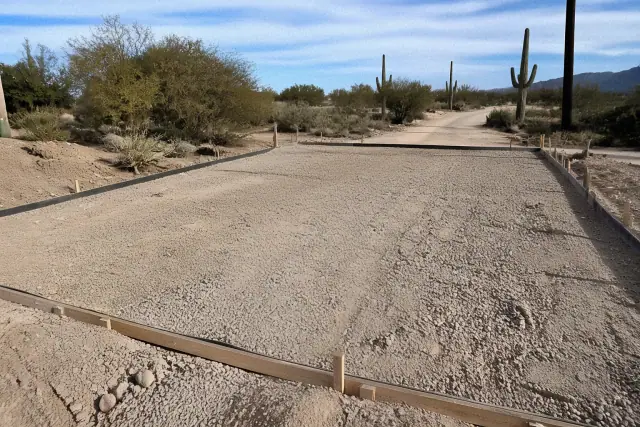
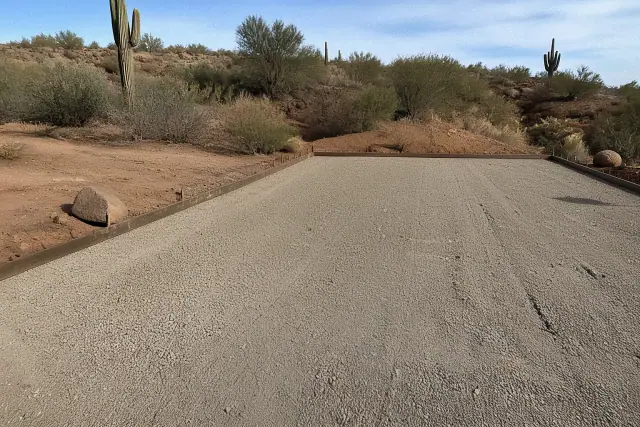
Gravel base prepared for a new concrete driveway installation in Tucson, AZ with desert terrain in the background.

We install new residential and commercial driveways with grading, compacted aggregate, forms, reinforcement, ready-mix placement, finishing, control joints, and curing planned as one system. The design is adjusted for passenger vehicles, work trucks, RVs, or commercial traffic.

Request Estimate

Driveway Demolition and Replacement

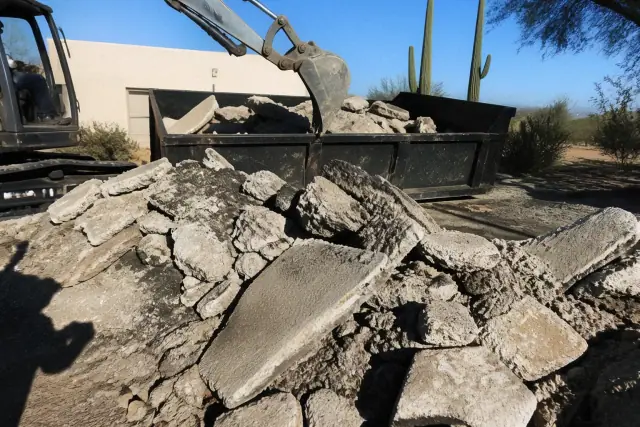
Heavy machinery breaking apart an old concrete driveway into rubble at a job site in Tucson, AZ.

When widespread cracks, repeated settlement, or a weak base make repair impractical, we remove the old asphalt or concrete, haul it away, and rebuild from the subgrade up. Replacement corrects underlying preparation problems instead of covering them with another temporary patch.

Request Estimate

Stamped and Decorative Driveways

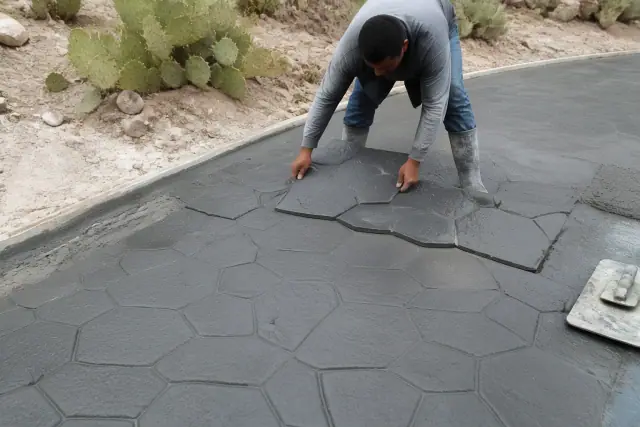
A worker imprinting a stone pattern onto a new concrete driveway with desert landscaping in the background in Tucson, AZ.

Stamped patterns, exposed aggregate, earth-tone stains, and integral color can coordinate a driveway with stucco, roof tile, and desert landscaping. Decorative choices are planned with slip resistance, intense UV exposure, and future sealing in mind.

Request Estimate

Concrete Repair and Resurfacing

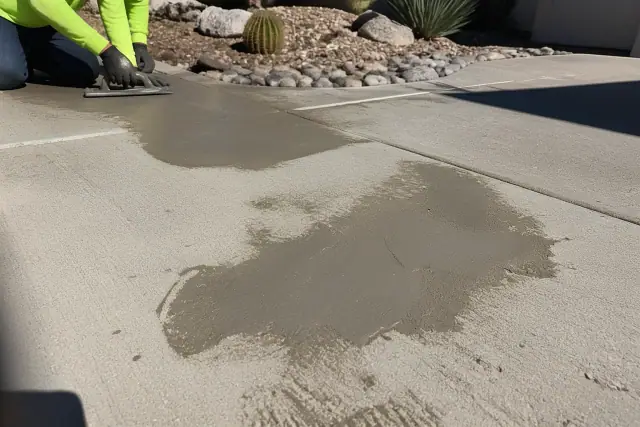
Contractor applying bonding compound to repair a concrete driveway in Tucson, AZ.

We evaluate cracks, settlement, spalling, and stains before recommending crack sealing, routing and patching, leveling, an overlay, or replacement. A structurally sound slab can often receive a fresh decorative topping without the cost and disruption of full demolition.

Request Estimate

Driveway Sealing and Maintenance

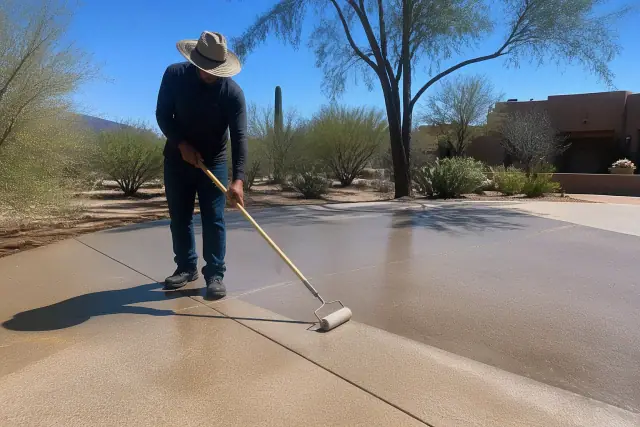
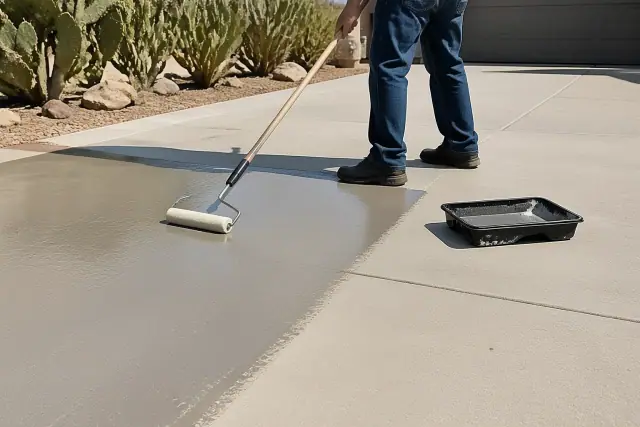
Worker using a roller brush to apply protective sealer to a concrete driveway in Tucson, AZ.

Breathable penetrating sealers such as silane or siloxane help limit water intrusion while allowing trapped vapor to escape in Tucson's heat. Pressure washing, prompt crack sealing, clear joints, and periodic resealing help slow surface degradation and staining.

Request Estimate

Commercial and Heavy-Load Driveways

Gravel base prepared for a concrete driveway installation at a job site in Tucson, AZ.

Commercial entrances and areas used by work trucks need more than a standard residential specification. We adjust thickness, concrete strength, reinforcement, and base preparation to the repeated wheel loads and operating conditions the slab will face.

Request Estimate
Driveway Design Options

Concrete Driveway Finish & Thickness Options

The right specification balances surface appearance with vehicle weight, existing soil, drainage, sun exposure, and maintenance. These common options can be combined; finish choice does not replace the need for correct thickness, reinforcement, base compaction, or curing.

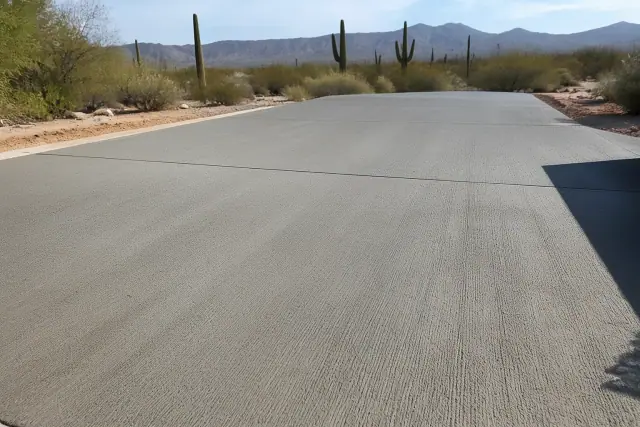
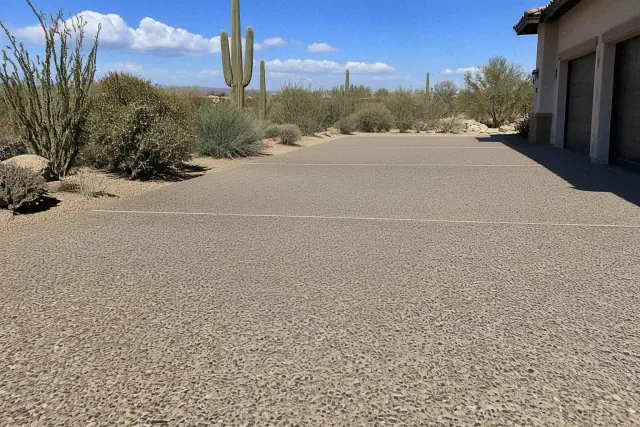
Broom-finish concrete driveway with a textured surface, saguaro silhouettes, and desert soil in Tucson, AZ.

Broom-Finish Concrete

A broom finish is a practical, budget-conscious choice for a standard residential driveway. Fine texture improves slip resistance while retaining a clean, traditional concrete appearance.

  • Commonly paired with a standard 4-inch residential slab
  • Textured for traction under foot and tires
  • Lower finish cost than stamping or decorative staining
  • Straightforward surface care and sealing
  • Suitable for many residential and commercial entries
Request Estimate
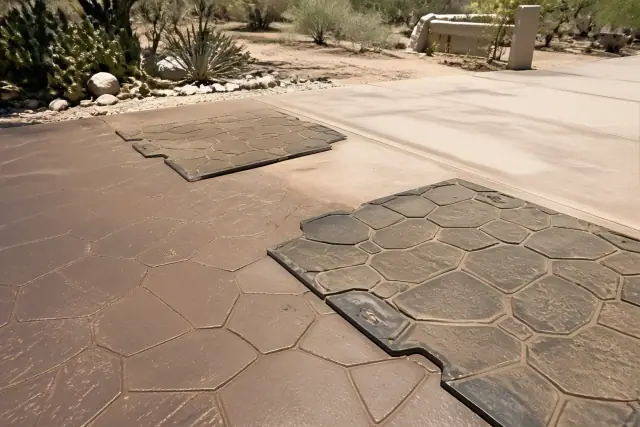
Textured mats imprinting a stone pattern onto a new concrete driveway in Tucson, AZ under harsh sunlight.

Stamped and Colored Concrete

Stamped concrete creates the look of masonry while retaining a continuous concrete slab. Release agents, integral color, and earth-tone stains can add variation that coordinates with custom homes and desert palettes.

  • Flagstone, cobblestone, brick, and ashlar-slate patterns
  • Integral color or stain selected around the home's exterior
  • Two-tone treatments for more natural pattern variation
  • Earth-tone stains chosen for intense Arizona UV exposure
  • Protective sealing suited to decorative concrete
Request Estimate
Exposed-aggregate concrete driveway surface with river rock texture in a Tucson, AZ desert landscape.

Exposed-Aggregate Surfaces

Exposed aggregate reveals the stone within the concrete for a durable, textured appearance. The variegated surface can disguise minor wear and desert dust better than a uniform smooth finish.

  • Distinctive stone texture without separate pavers
  • Slip-resistant surface for driveways and adjoining hardscape
  • Visual variation that helps mask light dust and wear
  • Compatible with breathable protective sealers
  • Useful for traditional or decorative driveway designs
Request Estimate
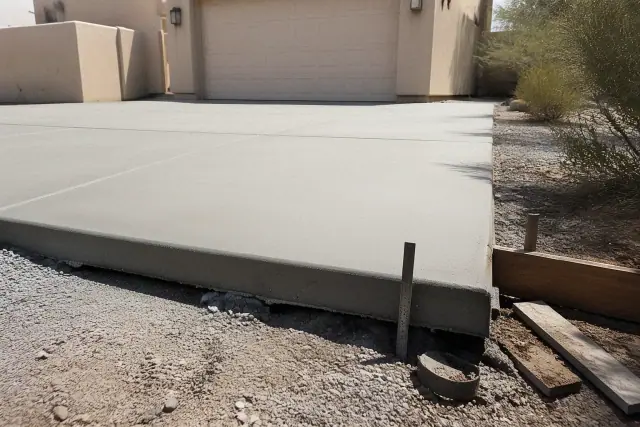
Completed concrete driveway showing slab thickness over a gravel base at a home in Tucson, AZ.

Load-Specific Slab Thickness

Thickness, concrete strength, reinforcement, and subbase work together to support vehicle traffic. Residential mixes are typically specified at 3,000 to 4,000 psi, with higher-strength mixes considered for commercial or heavy-vehicle areas.

  • 4 inches for most passenger cars and mid-size SUVs
  • 5 or 6 inches for work trucks, RVs, or repeated heavy loads
  • Wire mesh or rebar held in the intended slab position
  • Base depth increased when native soil tests poorly
  • Control joints planned around slab geometry and expected stress
Request Estimate
A roller brush applying protective sealant to a concrete driveway in Tucson, AZ with desert landscaping nearby.

Sealer and Maintenance Options

Sealer selection depends on the finish, moisture movement, desired appearance, and maintenance interval. New concrete should be sealed only after it is fully cured, with spring or fall providing a better Tucson application window than peak heat or monsoon conditions.

  • Acrylic topical sealer: typically 1 to 3 years
  • Penetrating silane or siloxane: typically 5 to 10 years
  • Polyurethane or epoxy hybrid: typically 3 to 5 years
  • Resealing interval: every 2 to 5 years based on product and sun exposure
  • Clear joints, pressure washing, and prompt crack sealing between applications
Request Estimate
Finding Your Right Fit

Choosing the Right Driveway Approach

Start with the intended vehicle load, slab condition, drainage, square footage, site access, demolition needs, and finish preference. A sound but worn slab may suit resurfacing, while widespread cracking or more than an inch of settlement usually points toward replacement. An itemized estimate should separate material, labor, preparation, and removal so the options are easier to compare.

Caliche-Aware Site Preparation

Tucson caliche drains poorly and can move unevenly when wet, so we grade first and compact aggregate in lifts before forming. Density checks and a stable 4- to 6-inch base help reduce settling under repeated wheel loads.

Licensed and Insured Concrete Contractor

Our driveway work follows Arizona Registrar of Contractors licensing standards and American Concrete Institute guidance for mix design, reinforcement, and joints. We carry contractor's liability insurance and pull required permits through the City of Tucson or Pima County for the job location.

Clear Estimates and Load-Specific Design

Each estimate breaks out material, labor, and site preparation rather than hiding major cost drivers. Slab thickness, reinforcement, mix strength, demolition, and finish are then aligned with the property's access and expected traffic.

What Sets Us Apart

Why Tucson Property Owners Choose Our Work

A durable Tucson driveway begins below the visible surface. Our approach connects soil preparation, drainage, reinforcement, finishing, curing, and maintenance to the actual property and vehicle loads, while clear estimates help owners understand the scope before work begins.

Request a Driveway Estimate

Poorly Prepared Caliche Subgrade

Concrete placed on loose native soil or uncompacted caliche can settle and crack as moisture changes beneath it. Driveways built without adequate base preparation may begin failing within two or three monsoon seasons instead of serving for decades.

Flat or Incorrect Drainage Slope

A flat slab can hold water or send runoff toward a garage and foundation. This matters during the July-through-September monsoon, when a storm can drop an inch of rain in under an hour, so grading should establish drainage before forms are set.

Inadequate Slab Reinforcement

Wire mesh left on the ground cannot perform as intended within the slab, and a rebar layout that ignores vehicle loads can allow cracks to spread. Reinforcement should be sized and positioned for the driveway's thickness and actual traffic.

Improper Control-Joint Spacing

Concrete naturally shrinks as it cures, and widely spaced or poorly timed joints leave cracking to chance. For typical driveway work, control joints are cut every 8 to 10 feet to guide that movement along planned lines.

Insufficient Thickness for Heavy Loads

A standard residential slab can be undersized for an RV, work truck, or repeated commercial use. Adding thickness and matching reinforcement before the pour is more dependable than asking a light-duty slab to carry loads it was not designed for.

UV and Monsoon Surface Wear

Unshaded concrete can exceed 150 degrees at the surface, while pavement temperatures can reach about 115 degrees during extreme heat. UV exposure, monsoon moisture, hard-water minerals, and caliche-related efflorescence can speed surface wear when sealing and crack maintenance are neglected.

How it works

Our Concrete Driveway Installation Process

A driveway pour depends on the work completed before the concrete truck arrives and the care taken after finishing. Our process moves from site evaluation and grading through base preparation, reinforcement, placement, curing, and sealing so each stage supports the next.

01.

Site Evaluation and Itemized Estimate

We review dimensions, access, existing concrete, drainage, soil conditions, vehicle loads, demolition, and finish goals. The estimate separates material, labor, and site preparation so the recommended scope and alternatives are clear.

02.

Demolition, Grading, and Drainage

If an old surface exists, we remove it before grading the exposed site. The planned 1 to 2 percent fall directs water away from the garage or foundation and reduces standing water during monsoon downpours.

03.

Compact the Base and Set Forms

Aggregate is placed in lifts and compacted to the density needed for vehicle support, with additional depth when native soil tests poorly. Forms then establish the driveway's edges, elevation, thickness, and transitions.

04.

Install Reinforcement and Order the Mix

Wire mesh or rebar is placed and supported according to the load requirement rather than left at the bottom of the slab. Ready-mix concrete is ordered from a local Tucson supplier at the strength and volume required for the driveway.

05.

Pour, Screed, and Finish

During placement, the crew screeds and floats the fresh concrete before applying the selected broom, exposed-aggregate, or stamped finish. Timely work is especially important in Tucson's dry heat, which can pull moisture from the surface quickly.

06.

Cure, Joint, Seal, and Maintain

We manage initial moisture, complete the joint layout, and protect the slab while it gains strength. Customers should stay off the new surface for about 7 days and avoid vehicle loads for the full 28-day design-strength period; a breathable sealer can be applied after curing is complete.

Plan Your Driveway

Schedule a Concrete Driveway Estimate

Tell us about the existing surface, driveway dimensions, vehicle types, drainage concerns, and preferred finish. Tucson Superior Concrete can outline the preparation, thickness, reinforcement, finishing, and removal included in the proposed work.

Driveway Planning Help

Concrete Driveway Installation FAQs

These answers cover common Tucson driveway questions about material costs, thickness, base preparation, installation timing, repairs, sealing, and local service coverage. A site-specific estimate is still needed because access, demolition, finish, and soil conditions affect the final scope.

Call Our Concrete Team

Ready-mix concrete in Tucson currently runs about $150 to $200 or more per cubic yard for material alone. Placement, screeding, floating, finishing, reinforcement, base work, and site access add to the installed cost, while a typical two-car driveway may use 5 to 8 cubic yards depending on its size and thickness.

The source pricing averages about $5.25 per square foot statewide, with a typical basic range of $3.50 to $7.00, while many Tucson homeowners budget $6 to $12 per square foot all-in. A typical project may fall between $4,000 and $10,000; a 20-by-40 driveway may reach $7,500 to $15,000 depending on finish, demolition, reinforcement, access, and site conditions.

Asphalt usually costs less upfront, but it can soften and rut in Tucson's extreme heat. Properly installed concrete typically lasts 25 to 30 years with routine sealing, compared with roughly 15 to 20 years for asphalt, so the longer service life can improve concrete's total value.

Yes, 4 inches is standard for a residential driveway carrying passenger cars and mid-size SUVs when the slab sits on a properly graded, compacted base. Work trucks, RVs, and repeated heavy loads may require 5 or 6 inches with heavier reinforcement.

Usually. Sidewalks are typically 3 to 4 inches thick because they support foot traffic, while driveways are generally at least 4 inches thick and use reinforcement suited to repeated wheel loads.

A standard residential project often takes 1 to 2 days for demolition, grading, and forming, followed by one day for the pour and finish. Weather, driveway size, access, and decorative stamping can extend that schedule, and curing time continues after the crew finishes.

Yes. We typically compact 4 to 6 inches of aggregate base to provide stable, even support and drainage over Tucson's caliche-heavy native soil, with more base considered when soil tests show poor load-bearing capacity.

For typical driveway work, control joints are commonly cut every 8 to 10 feet. The exact layout also considers slab geometry and transitions so normal shrinkage cracking is encouraged to follow planned lines.

Plan to stay off the new surface for about 7 days. Concrete reaches its full design strength for vehicle loads at about 28 days, so avoid parking on it until that curing period is complete.

Hairline cracks under an eighth of an inch are usually cosmetic and may be sealed, while a sound slab with surface wear may qualify for an overlay. Widespread cracking, repeated failure, or sections settled more than an inch usually indicate subgrade movement and make replacement the more dependable option.

Concrete resurfacing typically runs about $3 to $10 per square foot depending on overlay thickness and decorative treatment. It is appropriate only when the underlying slab remains structurally sound; unstable or badly settled concrete needs a different repair strategy.

Resealing is commonly recommended every 2 to 5 years, depending on the sealer, sun exposure, finish, and wear. Spring or fall is a better Tucson application window than peak summer or monsoon season because the product is less likely to flash-dry or be disrupted by rain.

Tucson Superior Concrete serves homeowners and businesses in Tucson, Oro Valley, Marana, Sahuarita, Vail, and the greater Pima County metro area. Permit requirements are handled through the City of Tucson Development Services Department or Pima County as the project location requires.