Proudly serving Tucson, Oro Valley, Marana, Sahuarita, Green Valley, Vail & surrounding areasCall or Text 24/7: 520-699-3263

Concrete Construction and Repair in Flowing Wells, AZ

Tucson Superior Concrete provides concrete driveway installation and full-service concrete work for homeowners and businesses in Flowing Wells, Arizona. Our services include patios, stamped concrete, sidewalks and walkways, slabs, foundations and footings, repairs, sealing, pool decks, and concrete removal. We scope each project around the property's soil, drainage, vehicle load, and intended use before recommending a mix, reinforcement plan, or finish.

Caliche and decomposed granite move through monsoon moisture and triple-digit summer heat, putting poorly prepared concrete at risk of premature cracking. Correct excavation, base compaction, drainage, reinforcement, and control-joint placement help a slab handle those local stresses. Our licensed and insured crew begins with an on-site evaluation and a free, itemized estimate so the work is clear before scheduling.

We serve properties along Flowing Wells Road, Prince Road, Romero Road, and River Road, as well as nearby Casas Adobes, Catalina, Amphitheater, Oro Valley, and the greater Tucson metro.

★ ★ ★ ★ ★4.9/5 Average Rating - 20+ Years of Experience - Flowing Wells Concrete Contractor Specialists - Residential & Commercial
Concrete Services
Concrete Services in Flowing Wells, AZ

Flowing Wells is an unincorporated Pima County community of roughly 16,419 people, with older ranch-style homes on quarter-acre lots and newer commercial development along its main corridor. We match each residential or commercial project to the site's load, drainage, and finish requirements. Property owners planning comparable work in Drexel Heights, AZ can expect the same site-specific evaluation process.

Concrete Driveway Installation

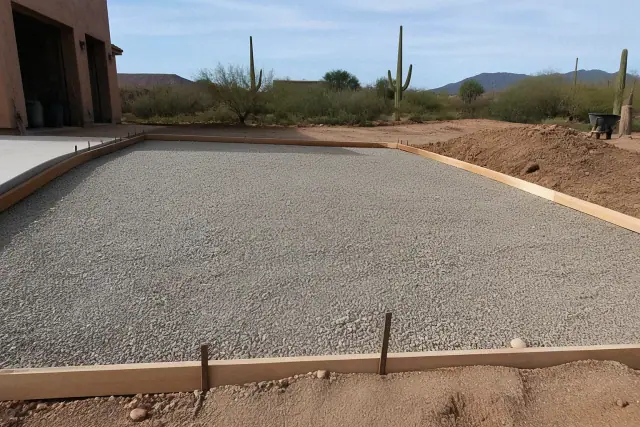
Concrete driveway subgrade preparation with gravel base and steel grid in a residential yard in Flowing Wells, AZ.

A standard two-car driveway typically covers 400 to 700 square feet and is poured 4 inches thick for passenger vehicles or 6 inches for trucks and RVs. We grade for drainage and offer broom, exposed-aggregate, and stamped-border finishes for new pours or full replacements.

Explore Service

Concrete Patio Installation

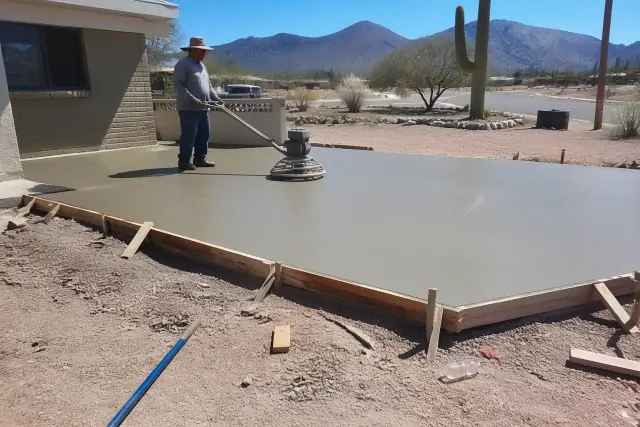
A worker uses a power trowel to smooth wet concrete inside wooden frames at a patio jobsite in Flowing Wells, AZ.

Patio slabs are poured at a 4-inch minimum with a light broom or salt finish for traction. Color, stamped patterns, correct slope, and planned joints create a practical outdoor surface that moves runoff away from the house.

Explore Service

Stamped Concrete

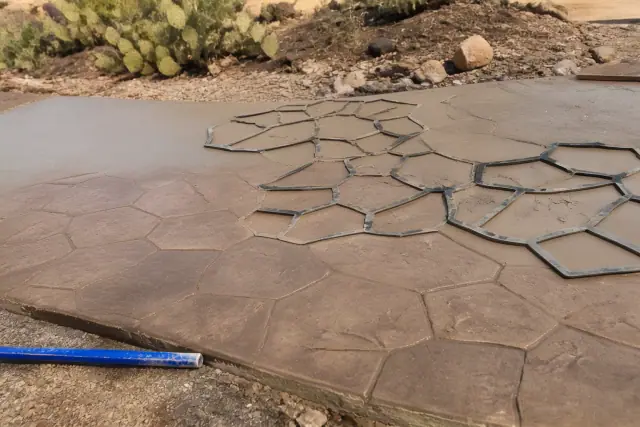
Stamped concrete with stone-like patterns on a jobsite with prickly pear cactus in Flowing Wells, AZ.

Stamped concrete can reproduce the appearance of flagstone, brick, or travertine for entries, courtyards, and pool surrounds. We texture and color the slab while it is plastic, then seal the finished pattern against aggressive UV exposure.

Explore Service

Concrete Sidewalks & Walkways

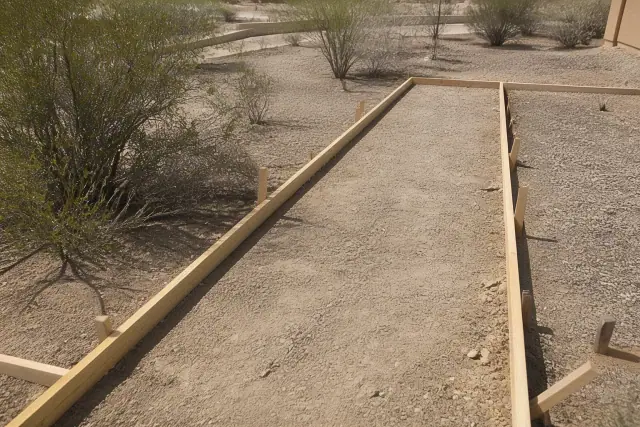
Wooden sidewalk forms secured with stakes along a path in a desert landscape in Flowing Wells, AZ.

Walkways are poured 4 inches thick over compacted base with a broom finish for slip resistance. Commercial paths are planned around ADA slope requirements, while residential paths can connect driveways, entries, patios, and backyards with coordinated accents.

Concrete Slab Installation

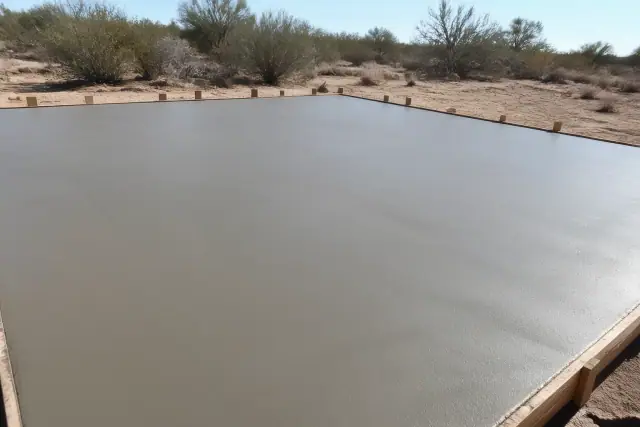
A newly poured, smooth concrete slab inside wooden frames at a job site in Flowing Wells, AZ, with desert soil nearby.

Shed pads, workshop floors, equipment slabs, and commercial floors are poured to the required PSI, thickness, and reinforcement schedule. Structural slabs receive a vapor barrier, and finishes range from steel-troweled interiors to broom-finished exterior pads.

Concrete Foundations & Footings

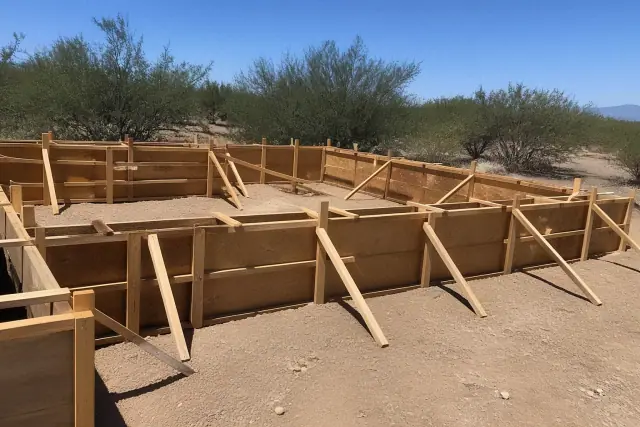
Wooden formwork for concrete foundations and footings at a construction site in Flowing Wells, AZ.

Footings are excavated to frost and load-bearing depth, then formed and reinforced to the approved structural drawings. We coordinate required Pima County or City of Tucson inspections and do not pour until the forms and rebar placement are checked.

Concrete Repair & Resurfacing

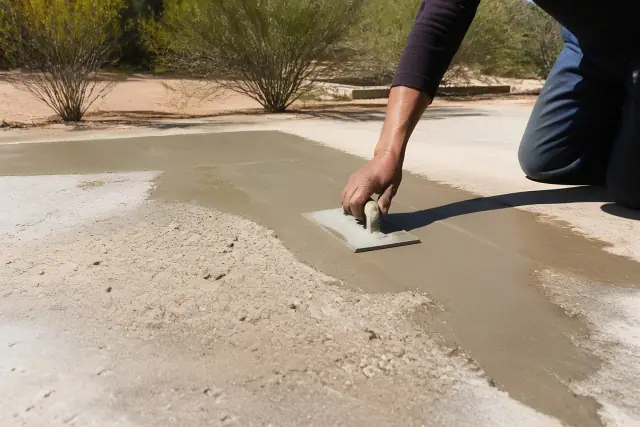
Technician troweling a bonding compound to repair pitted concrete in Flowing Wells, AZ.

When the underlying slab remains sound, grinding, epoxy or polymer-modified crack repair, and a bonded overlay can address spalling, pitting, and surface cracking. Resurfacing restores a uniform finish for less than demolition and replacement while extending the slab's useful life by years.

Concrete Sealing & Maintenance

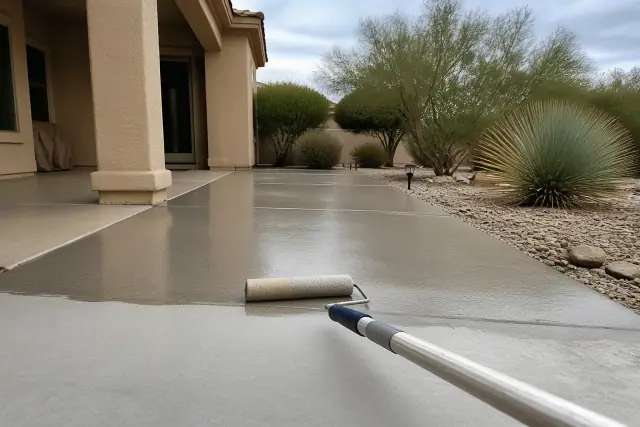
Roller brush applying clear concrete sealer to a surface in Flowing Wells, AZ, with desert homes in the background.

Penetrating silane-siloxane or acrylic topical sealers help protect exterior concrete from UV damage, oil, and monsoon moisture. Driveways and patios exposed to full sun generally need resealing every 2 to 3 years.

Concrete Pool Decks

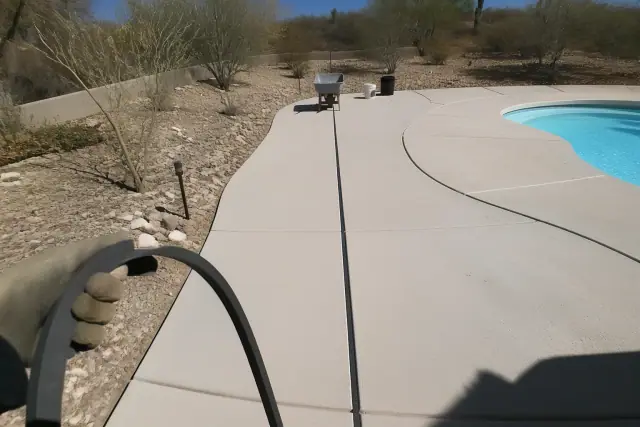
Flexible expansion joint material installed between concrete pool deck segments in Flowing Wells, AZ.

Bare concrete around a Flowing Wells pool can exceed 140 degrees in July. Light-colored finishes, knockdown texture, or cool-deck coatings improve barefoot comfort, while slip resistance, outward drainage, and expansion joints protect the pool surround.

Concrete Demolition & Removal

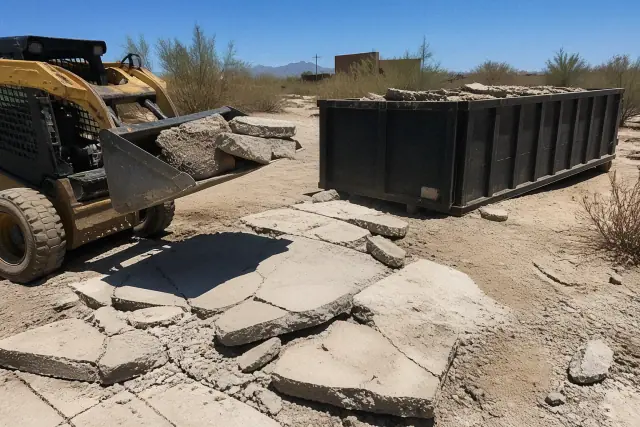
Heavy machinery breaking up old concrete and loading rubble into a container at a job site in Flowing Wells, AZ.

We break up and remove old driveways, patios, and slabs, load the debris for disposal, and prepare the exposed base for replacement. When scheduling allows, demolition and new placement are coordinated within the same mobilization.

Project Planning

How to Choose the Right Concrete Approach in Flowing Wells

The right concrete specification depends on what the slab will carry, how the site drains, and whether the existing concrete remains structurally sound. Base depth, slab thickness, reinforcement, joint spacing, finish, and maintenance should work together instead of being selected as isolated upgrades.

Compacted Base Preparation

Removing organic material and unstable fill before compacting a minimum 4-inch aggregate base gives the slab consistent support. That preparation is especially important where caliche and decomposed granite respond differently to moisture.

Slab Thickness & Reinforcement

Flatwork commonly uses a 4 to 6-inch slab and a 3,000 to 4,000 PSI mix, with the final specification matched to its load. Reinforcement may be wire mesh or #3 rebar on 18-inch centers for driveways and heavier applications.

Drainage & Grading

Positive drainage directs monsoon runoff away from garages, foundations, and pool coping. Forms and slopes should be set before the pour so water does not collect at slab edges and erode the supporting base.

Control Joint Spacing

Control joints are typically cut every 8 to 10 feet on flatwork so thermal expansion and soil movement create planned lines rather than random cracking. Joint layout also needs to follow corners and changes in slab geometry.

Finish Matched to Use

Broom finishes add traction, steel trowels suit interior floors, and exposed aggregate or stamped patterns add decorative texture. Pool decks benefit from light, slip-resistant surfaces, while exterior driveways need finishes that tolerate sun and traffic.

Repair or Replacement

Surface pitting, spalling, and non-structural cracking may be good candidates for bonded resurfacing when the slab beneath remains sound. Significant settlement or widespread structural failure usually points toward demolition, base correction, and replacement.

Flowing Wells Concrete Issues

Common Concrete Problems for Flowing Wells Properties

Local slabs must contend with cemented caliche, intense monsoon runoff, high surface temperatures, overnight freezes, and strong UV exposure. An on-site assessment helps separate cosmetic wear from drainage, base, or reinforcement problems that require a different repair plan.

Request On-Site Estimate

Caliche Soil Movement

Caliche is a cemented calcium-carbonate layer that does not drain or compact like ordinary fill. Uneven moisture movement beneath older driveways-many serving homes built from the 1950s through the 1970s-can produce settlement and diagonal cracks when base preparation is inadequate.

Monsoon Water Pooling

A monsoon storm can drop an inch of water in under an hour, overwhelming flat slabs with no positive slope. Water that stands against a foundation or slab edge accelerates spalling and can undermine the compacted base.

Extreme Surface Heat

Triple-digit summer weather heats exposed concrete enough to drive significant thermal expansion and speed surface moisture loss during a pour. Joint planning, weather-aware scheduling, and curing protection help manage movement and plastic-shrinkage cracking.

Spalling & Surface Pitting

Moisture intrusion, oil exposure, thermal cycling, and occasional overnight freezes can leave the surface scaled, pitted, or flaking. An air-entrained mix suited to the Tucson climate and timely sealing help limit freeze-thaw damage on exterior slabs.

Uncontrolled Cracking

Concrete naturally responds to temperature and soil movement, so missing or poorly spaced joints give cracks no planned path to follow. Correct base work, reinforcement, and joint placement are intended to prevent repairs as early as 8 years and support a 25 to 30-year service life instead.

UV Fading & Chalking

Strong sun can fade and chalk unsealed concrete within a few years, especially on decorative color and fully exposed flatwork. A sealer selected for the surface and renewed on the recommended cycle helps preserve appearance and resist moisture.

Why Choose Us

Why Choose Tucson Superior Concrete in Flowing Wells?

Concrete performance here depends on understanding local soils, weather, code, access, and property use together. Tucson Superior Concrete combines that local planning with licensed, bonded, and insured work, permit coordination, and a written scope that explains each phase before the pour.

Flowing Wells Soil Knowledge

Conditions can shift between heavier caliche and decomposed granite, changing excavation depth and aggregate-base needs. Familiarity with Flowing Wells properties, nearby commercial corridors, monsoon drainage, and extreme heat helps shape a site-specific plan instead of a generic square-foot quote.

Licensed, Bonded & Insured

We operate under Arizona Registrar of Contractors requirements and carry bonding and insurance for work on your property. Required permits and inspections are coordinated at the proper stages, with mix planning informed by American Concrete Institute guidance.

Itemized Project Planning

Written estimates separate demolition, excavation, base material, reinforcement, and finish work so the budget is easier to evaluate. We also account for engineer specifications, HOA requirements where applicable, equipment access, and commercial scheduling before setting the pour date.

Simple Process

Our Concrete Installation Process in Flowing Wells

A durable result comes from coordinating evaluation, permitting, site preparation, reinforcement, placement, finishing, and curing. Each phase is planned around the approved scope and the conditions observed on the property.

01.

On-Site Evaluation

We assess soil conditions, existing drainage, slab condition, dimensions, intended load, and access for equipment and concrete trucks. Those observations determine whether the project needs repair, replacement, or a new installation specification.

02.

Scope, Estimate & Permits

The written estimate breaks out the planned materials and work before scheduling. When required, permits are filed with Pima County Development Services or the City of Tucson according to the parcel's jurisdiction.

03.

Excavation & Base Compaction

The crew removes failed concrete, organic matter, and unstable fill, then excavates to the required depth. Aggregate base is placed and compacted to create uniform support beneath the new slab.

04.

Forms & Reinforcement

Forms establish the specified dimensions, elevations, and positive slope. Wire mesh or rebar is then placed for the project's load and checked before concrete placement, along with any required vapor barrier for structural slabs.

05.

Weather-Aware Pour & Finish

Placement is scheduled around peak summer heat and active monsoon weather, with earlier starts and evaporation control used when needed. The crew pours the specified mix and applies the selected broom, trowel, exposed-aggregate, stamped, or coated finish.

06.

Joints, Curing & Follow-Through

Control joints are cut while the slab is workable, then the concrete is protected through its early curing period. Foot traffic usually waits 24 to 48 hours, driveway vehicles roughly 7 days, and the slab continues gaining strength for 28 days; performance concerns during that window are addressed directly.

Project Applications

Concrete Solutions for Flowing Wells Homes & Businesses

Case Study 1: Driveway Planning: A two-car driveway scope can combine load-based thickness, reinforced base preparation, positive drainage, and a broom or decorative finish.

Case Study 2: Outdoor Living Surfaces: Patios, courtyards, walkways, and pool surrounds can coordinate color and texture while using slip resistance, slope, and expansion joints appropriate to each setting.

Case Study 3: Commercial and Structural Work: Higher-load slabs, sidewalks, foundations, and footings are planned around engineer specifications, inspection stages, access, and business-traffic needs.

Plan Your Project

Plan Your
Flowing Wells
Concrete Project

Request a free on-site estimate for a driveway, patio, slab, foundation, repair, pool deck, walkway, or removal project. We will evaluate the property and provide an itemized scope based on the site, materials, reinforcement, and finish.

Concrete Project Help

FAQs About Concrete in Flowing Wells, AZ

These answers cover local driveway costs, site preparation, curing, permitting, finishes, repairs, maintenance, and scheduling. A property evaluation is still the best way to confirm the right scope for a specific slab.

Call Our Concrete Team

Standard driveway installation in the Flowing Wells and Tucson market generally runs $3 to $7 per square foot, while ready-mix is around $92 to $102 per cubic yard depending on PSI and additives. A typical 400 to 700-square-foot residential driveway is about $1,200 to $4,900 before special finishes, site-specific excavation, or equipment hauling.

Passenger-vehicle driveways are commonly poured 4 inches thick, while slabs serving trucks or RVs may need 6 inches. The final thickness, strength, and reinforcement depend on vehicle load and site conditions.

The process starts by removing unstable material and compacting an aggregate base beneath the slab. Depending on the load, reinforcement may use wire mesh or rebar, with heavier driveway work commonly using the rebar schedule described in the project scope.

Foot traffic usually waits 24 to 48 hours, and driveway vehicle traffic waits roughly 7 days. Concrete continues gaining strength for 28 days, so the slab should be protected through the early curing period.

October through April usually provides the most predictable curing conditions. June through September brings monsoon risk, while July and August pours need earlier starts, evaporation control, and close protection during the first 48 hours; summer work is still possible with careful coordination.

Permits are pulled when required, and the responsible jurisdiction may be Pima County Development Services or the City of Tucson depending on the parcel. Foundations and footings also require inspections at the stages shown on the approved plan set.

Caliche and decomposed granite move as moisture and temperature conditions change, while flat lots can hold monsoon runoff near slab edges. Proper excavation, compacted base, reinforcement, positive drainage, and planned control joints reduce random cracking but cannot make concrete completely motionless.

Resurfacing can work when spalling, pitting, or surface cracking is present but the underlying slab remains structurally sound. Significant settlement or structural failure generally calls for removal, base correction, and replacement.

Driveways and patios exposed to full sun generally need resealing every 2 to 3 years. Penetrating silane-siloxane and acrylic topical sealers serve different surfaces, so the product should match the finish and how the slab is used.

Options include broom, salt, exposed aggregate, integral color, and stamped patterns that resemble flagstone, brick, or travertine. Finish selection should account for traction, heat exposure, maintenance, and the surrounding architecture.

Light-colored finishes, knockdown texture, or cool-deck coatings help reduce barefoot heat and improve traction. The deck should also slope away from the coping and use expansion joints to isolate its movement from the pool shell.

Yes. The source scope includes commercial slabs and sidewalks, equipment pads, foundations, and footings, with higher-strength mixes and rebar schedules built around engineer specifications when provided. Commercial walkways are also planned to meet applicable ADA slope requirements.

Service extends along Flowing Wells Road, Prince Road, Romero Road, River Road, and nearby residential streets. The stated coverage also includes Casas Adobes, Catalina, Amphitheater, Oro Valley, central Tucson neighborhoods, and the greater Tucson metro.

Mix strength and air entrainment are selected for local thermal and freeze-thaw conditions, while pour timing changes around extreme heat and storms. Control joints manage expansion, and sealing helps exterior surfaces withstand UV exposure and monsoon moisture.

The free written estimate can itemize demolition, excavation, base material, reinforcement, and finish work after an on-site evaluation. Estimates can typically be scheduled within a few days, and the scope can be adjusted around a set budget before the crew is scheduled.