Proudly serving Tucson, Oro Valley, Marana, Sahuarita, Green Valley, Vail & surrounding areasCall or Text 24/7: 520-699-3263

Concrete Installation and Site Preparation Services in Casas Adobes, AZ

Tucson Superior Concrete installs concrete driveways, patios, stamped surfaces, sidewalks, slabs, foundations, pool decks, and related flatwork for homes and businesses throughout Casas Adobes. We also repair, resurface, seal, maintain, demolish, and remove existing concrete when a property needs a fresh start. Each project is planned around the intended load, finish, drainage, and access conditions. Our work covers both new construction and replacement projects.

Caliche hardpan, monsoon runoff, and 100-plus-degree summer heat make local concrete preparation especially important. In a community of roughly 70,973 residents, older ranch homes, newer custom builds, and Oracle Road commercial properties can present very different site conditions. Unshaded driveway surfaces can pass 150 degrees, while poorly graded slabs can hold stormwater against a garage or foundation. We assess the ground, drainage, reinforcement, and curing plan before concrete placement so the scope fits the property.

We serve properties near Ina Road, Oracle Road, and La Cholla Boulevard, as well as sites bordering Oro Valley and Catalina Foothills. Request a site visit and written estimate for a new pour, replacement, or repair.

★ ★ ★ ★ ★4.9/5 Average Rating - 20+ Years of Experience - Casas Adobes Concrete Contractor Specialists - Residential & Commercial
Concrete Services
Concrete Services in Casas Adobes, AZ

Our concrete services cover new flatwork, structural pours, decorative finishes, repairs, maintenance, and removal. Each option is adapted to the site's soil, drainage, traffic, and finish requirements; property owners comparing similar desert-ground planning can also review our Tanque Verde, AZ location page.

Concrete Driveway Installation

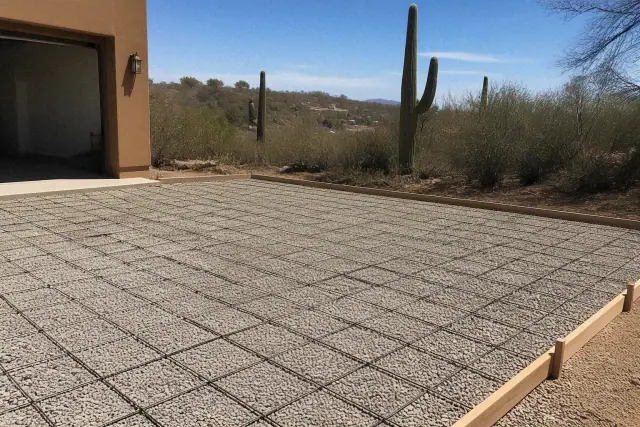
Leveled gravel base for a concrete driveway with a steel reinforcement grid in Casas Adobes, AZ.

We install and replace residential driveways and commercial approaches with excavation, compaction, drainage grading, reinforcement, and control joints planned for desert conditions. Passenger-vehicle driveways commonly use a 4-inch slab, while trucks, RVs, and heavier commercial traffic may call for 5 or 6 inches.

Explore Service

Concrete Patio Installation

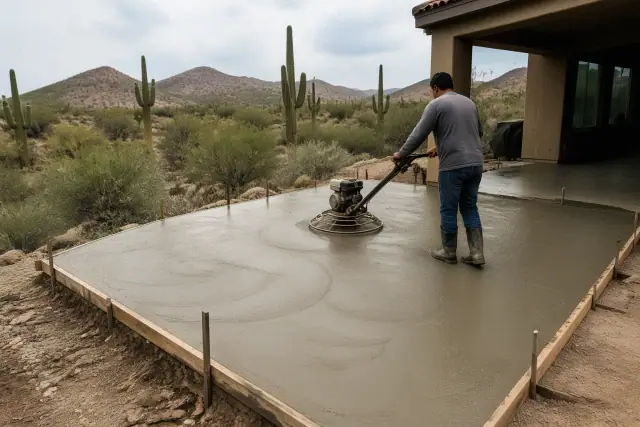
Worker using a power trowel to smooth fresh concrete on a patio project in Casas Adobes, AZ.

Patios are sized and sloped to fit the yard, move summer rain away from the house, and avoid pooling at thresholds. Broom, stamped flagstone, and stamped travertine finishes can complement Southwest architecture while proper base compaction and joint spacing support the slab below.

Explore Service

Stamped Concrete

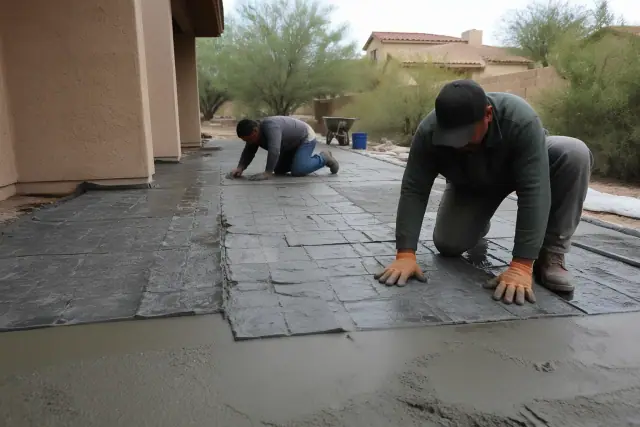
Technician pressing textured mats into wet concrete at a job site in Casas Adobes, AZ.

Stamped concrete can recreate paver, brick, flagstone, or travertine patterns for patios, pool decks, and entries. Integral color, color hardener, or acid stain sets the tone, and resealing every 2 to 3 years helps protect decorative color and texture from UV exposure and wear.

Explore Service

Concrete Sidewalks & Walkways

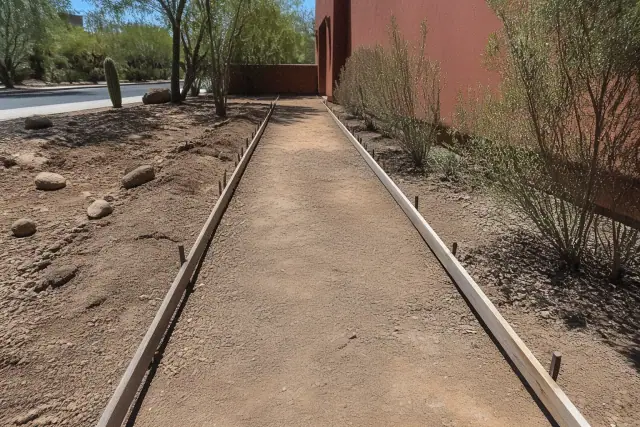
Wooden forms for a new concrete sidewalk at a job site in Casas Adobes, AZ, surrounded by desert scrub.

We pour walkways at a minimum 4-inch thickness with a broom finish for slip resistance and grades that connect cleanly to existing hardscape. For HOA and commercial work, width and cross-slope planning follows applicable Pima County Development Services accessibility specifications.

Concrete Slab Installation

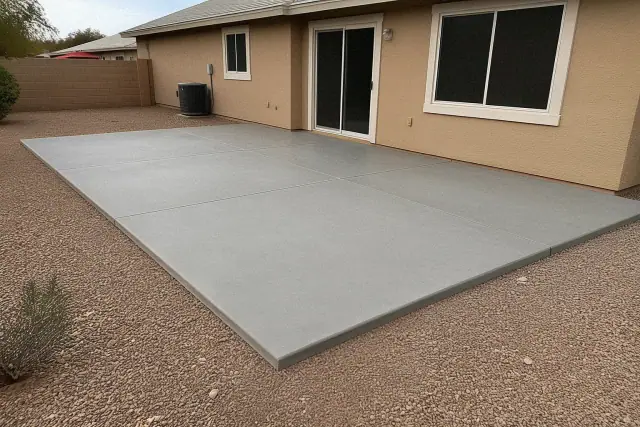
Completed concrete patio slab with broom texture and control joints at a home in Casas Adobes, AZ.

Shed pads, garage floors, and workshop slabs begin with subgrade compaction to 95 percent density, followed by a vapor barrier where moisture intrusion is a concern. Light-storage slabs commonly use 4-inch concrete, with thicker sections and rebar selected for vehicles or heavy equipment.

Concrete Foundations & Footings

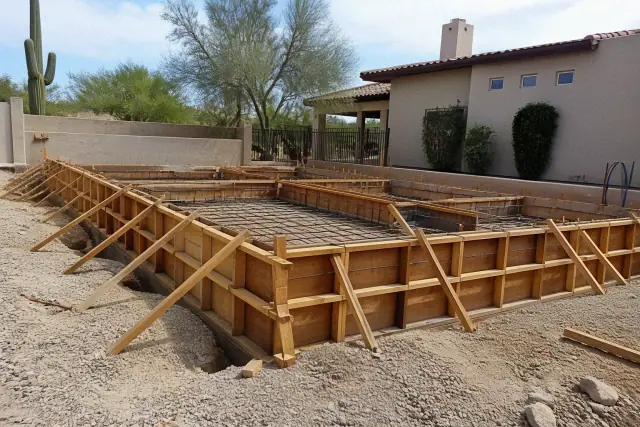
Concrete foundation footings with wooden formwork and steel rebar at a residential site in Casas Adobes, AZ.

Foundation and footing excavation may require mechanical breaking where dense caliche blocks the required depth. We size reinforcement and depth to the structural load and soil bearing capacity, follow the residential and building codes adopted by Pima County, and coordinate required inspections before backfill.

Concrete Repair & Resurfacing

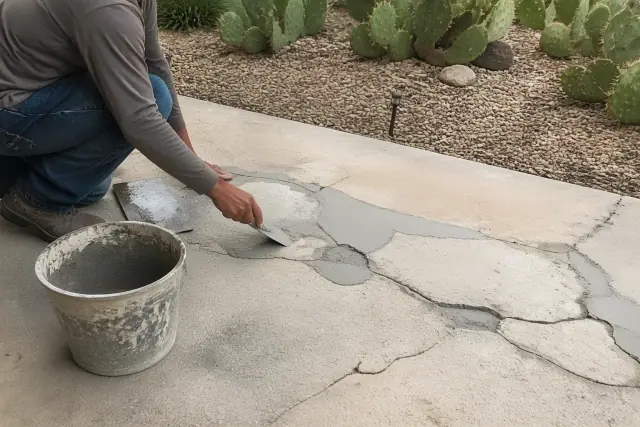
Contractor repairing pitted concrete flooring with patching compound in Casas Adobes, AZ.

Repair options include routing and sealing active cracks, bonded overlays for worn surfaces, and concrete leveling for settled sections. Overlays typically range from a quarter-inch to two inches thick, depending on slab condition and whether decorative stamping or coloring is included.

Concrete Sealing & Maintenance

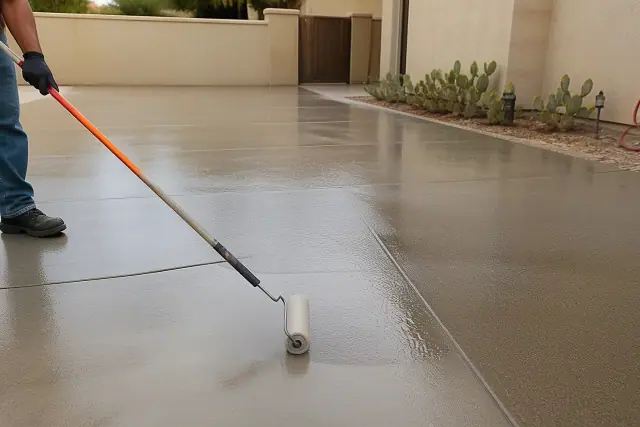
Applying transparent sealer to a concrete driveway in Casas Adobes, AZ, near prickly pear cacti and stucco homes.

Maintenance starts with pressure washing before sealer application. Penetrating silane-siloxane products suit driveways and traffic-bearing slabs, while acrylic sealers support decorative sheen; reapplication commonly falls every 2 to 5 years based on sun and traffic exposure.

Concrete Pool Decks

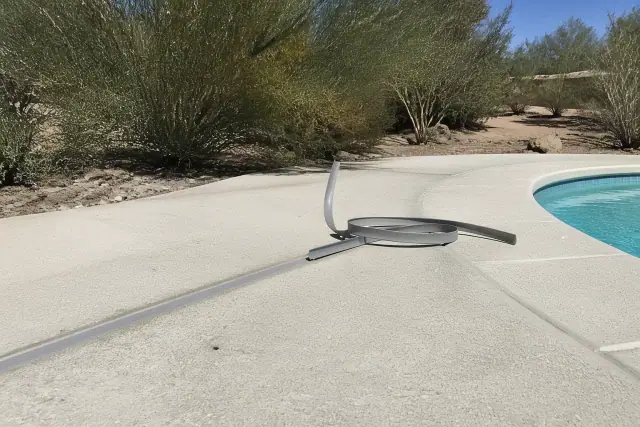
Flexible joint filler installed between concrete pool deck segments at a job site in Casas Adobes, AZ.

Pool decks can use broom, knockdown, or stamped textures selected for slip resistance and a more comfortable surface under desert sun. The deck is sloped away from coping so water reaches drains instead of moving toward the pool shell or house foundation.

Concrete Demolition & Removal

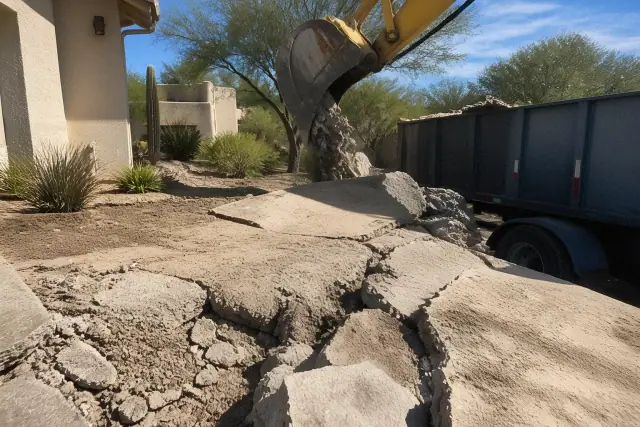
Heavy machinery breaking up old concrete and loading rubble into a container at a residential site in Casas Adobes, AZ.

When a cracked driveway, patio, or pool deck cannot support the planned repair, we break out the old concrete before excavation and replacement. Removal and debris hauling are included in the project scope so the exposed subgrade can be evaluated and rebuilt as needed.

Project Planning

Choosing Concrete for Your Project

The right concrete scope depends on what the slab must carry, how water moves across the property, and what finish the space requires. Site preparation, reinforcement, joints, curing, and maintenance should be selected together rather than treated as separate add-ons.

Site Conditions and Drainage

Caliche can sit anywhere from a few inches to several feet below grade, so excavation needs vary by property. Driveways and patios should also carry a minimum 2 percent slope away from structures to control monsoon runoff.

Slab Thickness and Load

A storage pad, passenger driveway, RV approach, and equipment slab do not carry the same load. A standard 4-inch section may fit light use, while 5- or 6-inch concrete with added reinforcement may be appropriate for trucks, RVs, and commercial traffic.

Reinforcement and Joint Plan

Driveways and slabs may use 6x6 W1.4 welded wire mesh or #3 rebar on 18-inch grids, depending on load and soil conditions. Joint spacing is commonly 2 to 3 times the slab thickness in feet, placing joints about every 8 to 12 feet on a 4-inch driveway.

Finish and Slip Resistance

Broom, exposed aggregate, stamped, knockdown, troweled, and hand-textured finishes serve different appearance and traction goals. Pool surrounds and entries benefit from texture, while acid and water-based stains expand the color choices for decorative work.

Sealer and Maintenance

Select sealer by surface use rather than sheen alone. Penetrating products suit sun- and vehicle-exposed flatwork, while decorative acrylic sealers protect color and texture; pressure washing prepares either surface for an even application.

Written Scope and Estimate

A useful estimate identifies square footage, excavation, thickness, reinforcement, finish, access, and removal needs before trucks arrive. Arizona ready-mix runs roughly $130 to $166 per cubic yard by PSI rating, with delivery adding about $130 to $280 per truck, so site-specific quantities matter.

Desert Concrete Issues

Common Concrete Problems on Desert Properties

Concrete failures often begin below the surface or during curing, then appear later as cracks, settlement, pitting, or drainage problems. A site review helps identify whether repair, leveling, resurfacing, or replacement fits the condition.

Request Site Estimate

Caliche and Settlement

Dense caliche may require ripping or mechanical breaking before a base can be excavated and compacted correctly. Concrete placed over uncompacted caliche fill can look sound at first yet begin cracking after two or three seasons as the support shifts.

Monsoon Water Pooling

The July-through-September monsoon season can send intense rainfall across hard ground faster than it absorbs. Incorrect grades allow water to pool at thresholds and foundations, where moisture can enter existing hairline cracks.

Extreme Surface Heat

Unshaded concrete regularly exceeds 140 degrees in June and July. That heat accelerates curing, affects finish timing, and makes early placement plus curing compounds or blankets important for retaining moisture.

Rapid-Moisture Cracking

Low humidity can pull surface moisture from fresh concrete quickly. Without timing and curing controls, plastic shrinkage cracks may form within the first 24 hours and weaken the surface over time.

Spalling and Pitting

Years of UV exposure, thermal cycling, traffic, and uneven moisture absorption can leave a slab pitted or spalled. Bonded resurfacing may restore a sound slab, but active cracks and unstable sections need separate repair or leveling first.

Roots and Unverified Fill

Established properties with mature desert landscaping may have roots near walkways and patios, while newer graded lots can contain compacted fill that needs verification. Both conditions should be assessed before a new slab replaces damaged flatwork.

Why Choose Us

Why Choose Tucson Superior Concrete in Casas Adobes?

Structural concrete depends on work that disappears below the finished surface: excavation depth, compaction, reinforcement, drainage, and joint placement. As a licensed concrete contractor, we plan those details for local ground and climate conditions, coordinate permits when required, and review completed work with the customer.

Local Caliche Experience

We evaluate whether caliche, native soil, or graded fill is supporting the planned slab and adjust excavation and compaction accordingly. This site-by-site approach also accounts for drainage, truck access, mature landscaping, and nearby structures.

Code-Aware Structural Planning

Our planning incorporates ACI 318 for structural concrete and ACI 330 for vehicle-bearing slabs, along with codes adopted by Pima County. Residential driveways and patios commonly use 3,500 to 4,000 PSI concrete here, compared with the 2,500 to 3,000 PSI mixes sometimes used in milder climates.

Workmanship Accountability

We walk the finished project with the customer and address issues that trace back to our workmanship. Preparation is often the difference between a driveway that reaches 25 to 30 years and one needing resurfacing around year eight, so the base and reinforcement receive the same attention as the visible finish.

Simple Process

Our Concrete Installation Process in Casas Adobes

The process moves from site review and excavation through forms, reinforcement, placement, finishing, joints, and curing. Required inspections, removal work, access, and monsoon scheduling are built into the scope before placement day.

01.

Site Visit and Estimate

We inspect soil, drainage, existing concrete, dimensions, equipment access, and the load the finished slab must carry. The written scope identifies excavation, thickness, reinforcement, finish, demolition, and inspection needs.

02.

Excavation and Base Preparation

Old concrete is removed when required, caliche is broken through as needed, and the subgrade is graded and tested to 95 percent standard Proctor density. A compacted aggregate base typically 4 to 6 inches deep then provides drainage and support.

03.

Forms and Reinforcement

Forms establish the exact footprint, thickness, elevations, and slope. Wire mesh or rebar is placed for the application, while expansion-joint material separates the pour from garage foundations and other structures.

04.

Placement and Finishing

Concrete is placed, screeded to grade, and finished with the selected broom, stamp, aggregate, knockdown, or smooth texture. Summer work may begin before sunrise to control moisture loss, and monsoon weather can shift the planned pour by a day or two.

05.

Joints and Curing

Control joints are cut or tooled at the specified spacing, then curing compounds or blankets slow surface moisture loss. Allow a minimum of 7 days before load-bearing use; concrete continues developing strength through the 28-day testing benchmark.

06.

Inspection and Final Walkthrough

For permitted foundations and additions, we coordinate Pima County Development Services inspections at the required stages. After finishing and cleanup, we review the completed surface, drainage, curing restrictions, and maintenance plan with the customer.

Practical Outcomes

Concrete Project Goals for Homes & Businesses

Case Study 1: Driveway planning: Match excavation, base, thickness, reinforcement, and joint spacing to passenger vehicles, RVs, trucks, or commercial entrances.

Case Study 2: Outdoor living surfaces: Combine drainage slopes with broom, stamped, knockdown, or stained finishes for patios, entries, walkways, and pool decks.

Case Study 3: Repair and maintenance: Use crack sealing, leveling, bonded overlays, pressure washing, and the right sealer where the existing slab remains suitable for restoration.

Plan Your Project

Schedule a Concrete
Site
Consultation

Tell us whether you are planning a driveway, patio, slab, foundation, pool deck, repair, or removal project in Casas Adobes. We will walk the site, review soil and drainage conditions, discuss finishes and load needs, and prepare a written estimate.

Local Concrete Help

Concrete FAQs for Casas Adobes, AZ

These answers cover the cost, design, site preparation, finishing, curing, repair, and maintenance details that shape local concrete projects. A site visit is still needed to match the scope to your soil, drainage, access, and intended load.

Call Our Concrete Team

Nationally, concrete driveway installation runs between $8 and $20 per square foot. A standard 600 square foot driveway typically falls between $3,600 and $9,000 depending on reinforcement, finish, thickness, and site preparation; your written estimate should use actual dimensions and excavation needs.

Ready-mix concrete in Arizona runs roughly $130 to $166 per cubic yard depending on the specified PSI rating, and delivery adds about $130 to $280 per truck. Project price also changes with square footage, slab thickness, excavation, reinforcement, access, demolition, and finish selection.

A standard passenger-vehicle driveway is commonly formed at 4 inches. Driveways serving trucks, RVs, or heavy commercial traffic may require 5 or 6 inches with reinforcement selected for the load and soil conditions.

Caliche is a dense, cemented calcium-carbonate layer that can sit from a few inches to several feet below grade. It may need mechanical breaking before excavation, and any disturbed or filled area must be compacted correctly to reduce settlement beneath the slab.

Residential driveways and patios commonly use 3,500 to 4,000 PSI concrete in this climate. Depending on soil and load, reinforcement may be 6x6 W1.4 welded wire mesh or #3 rebar on 18-inch grids, while structural foundations use rebar sized to engineering requirements.

Control-joint spacing is roughly 2 to 3 times the slab thickness in feet. For a standard 4-inch driveway, that places joints about every 8 to 12 feet so curing shrinkage is encouraged to occur at planned lines.

Local flatwork should generally carry a minimum 2 percent slope away from garages, foundations, and other structures. During the July-through-September monsoon season, that grade helps short, intense rainfall reach drains or safe discharge areas instead of pooling at thresholds.

Allow at least 7 days before vehicle use or other load-bearing traffic. Concrete continues developing strength for 28 days, which is the standard benchmark used for compressive-strength testing.

Yes, but placement and curing have to account for low humidity and concrete surfaces that regularly exceed 140 degrees in June and July. Early-morning pours, sometimes before sunrise, plus curing compounds or blankets help slow moisture loss and reduce plastic shrinkage cracking during the first 24 hours.

Stamped concrete is typically resealed every 2 to 3 years in this climate. The sealer helps protect integral color, color hardener, or stain from UV fade and wear while preserving the stamped texture.

Driveways and patios commonly need sealer every 2 to 5 years depending on sun exposure and traffic. Penetrating silane-siloxane products fit driveways and slabs, while acrylic sealers are used where decorative sheen matters; pressure washing comes first.

Hairline and active cracks may be routed and sealed, settled sections may be leveled, and a sound but worn slab may accept a bonded overlay. Overlays typically range from a quarter-inch to two inches thick, but unstable base conditions or severe damage can make demolition and replacement the more suitable scope.

New foundations and additions typically require permitted inspections before backfill. We coordinate with Pima County Development Services and plan structural work around the adopted residential and building codes, soil bearing capacity, reinforcement, and project loads.

We serve Casas Adobes end to end, including properties near Ina Road, Oracle Road, and La Cholla Boulevard. Our local coverage also reaches sites bordering Oro Valley to the north and Catalina Foothills to the east.

The sequence includes layout, excavation, grading, compaction, a typically 4- to 6-inch aggregate base, forms, reinforcement, placement, finishing, joints, and curing. Demolition and debris hauling happen first when needed, and monsoon weather can move the scheduled pour by a day or two.